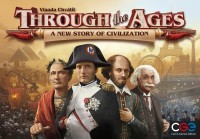
A while back a few, I played a game of the original Through the Ages online with my co-workers. It was a memorable experience to say the least, with a back and forth swing of power as we would all ebb and flow with power through the ages. I wanted the game, but avoided it due to its length and age.
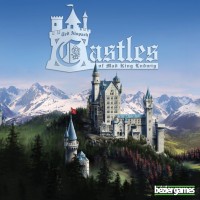
Castles of Mad King Ludwig replaced Suburbia in my collection a while back and looking at it now, it was certainly the correct decision. It’s a little faster, especially if the players have played Suburbia before, and it has a lot less bookkeeping. Also, a city of regular hexagons doesn’t have a ton of variety or story, but a fully built castle with different rooms always tells a funny story (my castle’s owner was clearly an evil villain with his torture chamber, underground grotto, and train room.
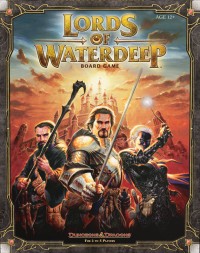
I enjoy worker placement games and I have a good number of them. In general, none of them are revolutionary or groundbreaking. Instead they just have slight changes from one to another. Lords of Waterdeep is definitely an iterative design and nothing here is mind blowing, but it is very smooth and well designed. The rules make sense and the game is easy to teach. In fact, you’d be able to teach this to almost anyone who’s willing to pay attention to you for a few minutes
I’ve always wanted to enjoy a dexterity game, but both of the previous games that I tried I really didn’t enjoy: Catacombs and Ascending Empires. Both were too long and fiddly with lots of little rule problems caused by the odd flick here or there. However, I didn’t like the idea of playing what I felt should have been a light game for over an hour, it just felt dragged out.
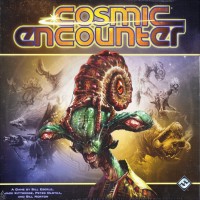
I seem to only be able to win this game jointly, which is probably a factor of teaching the game to new folks most of the time, but I still love the stories this game produces. In this particular game I had surged to a pretty early lead with three points versus some folks with two, one, or zero points. However, that’s never a good sign in this game and everyone started ganging up against me as the destiny deck dealt my color or wilds repeatedly. Sitting firmly with three points and everyone else but one person has four points, I’m now in last with one other person. Well, as I said before, we ended up winning due to a 40 point encounter card while allied with the other person in last and then I drew one more encounter card and it was his card. I said, “want to negotiate?” and, we both had the right card and that was a win!
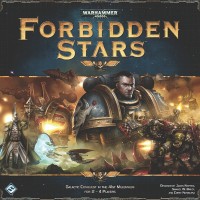
My first play of Forbidden Stars was pretty abysmal, resulting in something of a rage quit. However, my second game went much better—thankfully.
The general gist of the game is you’re one of four Warhammer 40k factions attempting to recover enough objectives to win within eight rounds. You’ll do that by conquering certain planets which will require some movement (and combat), upgrades, building/recruiting, and domination (extracting resources). Most of these actions are straightforward—with combat being an exception—but the way you plan your turn is very interesting: you have eight order tiles (two of each action) and you play the tiles face down on the sector tiles and resolve them from the top down. If there are other tiles already there, you play on top, so you can now prevent that person from using that action for a bit. The game ends in eight rounds, and the person with the most objectives wins, in case of a tie you use planets, if that ties, you use units.
Every time I play Quantum, I’m reminded of why I’ve purchased this one twice and I sold myself for having sold it at any point. Quantum takes a normally long and unwieldy genre—4x (eXplore, eXpand, eXploit, eXterminate)—and compresses it down into a simple to teach, simple to learn, and hard to master game. I love a lot of the clever bits:
1 play with 3 players and 1 play with 2 players in the past two weeks
Played before
I’ve mostly played Elysium with 3 or 4 players, so it was nice to finally be able to try the game with only 2 players. With 2 players, it’s definitely a much faster game since the number of cards drafted stays the same. Also, I feel like your choices open up quite a bit as each player can develop an individual strategy.
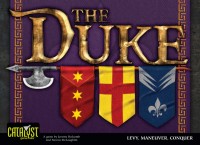
This is one of those games that just doesn’t get to the table nearly as much as I’d like since it’s two players only. It takes what I like about chess (its strategy and different movements) and removes what I don’t like (its static setup). I like that a piece’s movement changes after moving and that each piece does something slightly different. I do find myself looking up the very short rules since I don’t play it often, but if you played quite a bit, this would be a 10-20 minute game each time.
This is a game that just doesn’t get played nearly enough for my preferences. It’s one of the few team games I own and it’s about the only way I can play a war game. If you haven’t played it before, it’s a very light area control board game where you have four players that represent the colonial militia, the Continental Army, the loyalist militia, and the British regulars. Each faction has a certain birthdays. Those guys have a number of hit symbols, flee symbols, and blanks. The British regulars are the strongest and they have the most hit symbols and no flee symbols. On the other hand, the militias are pretty weak with there two hit symbols and to flee symbols. However, to make up for the weakness of the militias they get three dice whereas the armies get two dice. In addition, you get to replace those fled armies later.